North Korea vs South Korea Flag: Two Koreas, Two Very Different Flags
By Mohamadou Moctar · Last updated
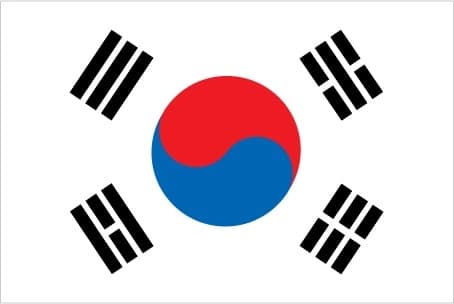
Despite sharing a peninsula and thousands of years of common history, North Korea and South Korea have flags that look nothing alike. South Korea's Taegukgi features a white background with a red-and-blue yin-yang symbol (taegeuk) and four black trigrams, rooted in East Asian philosophy. North Korea's flag uses bold red, white, and blue horizontal stripes with a red star on a white disc, reflecting its communist ideology. The stark contrast in flag design mirrors the dramatic political divergence that began in 1945.

Key Differences
- South Korea uses a white background with a taegeuk (yin-yang) and four trigrams; North Korea uses horizontal red, white, and blue stripes with a red star.
- South Korea's design is rooted in Confucian and Taoist philosophy; North Korea's reflects Soviet-influenced communist symbolism.
- South Korea's flag has no stripes; North Korea's has 5 horizontal bands (blue-white-red-white-blue).
- South Korea adopted its flag in 1948 (based on an 1882 design); North Korea adopted its flag in 1948.
- South Korea's flag is asymmetric (trigrams differ in each corner); North Korea's is symmetric around the center.
Similarities
- Both use red, blue, and white as primary colors.
- Both were adopted in 1948 when the two states were formally established.
- Both replaced the traditional Korean flag that was used before partition.
- Both flags carry deep symbolic meaning tied to their respective national ideologies.
Why Do North Korea and South Korea Flags Look So Similar?
The two flags share red, blue, and white because these colors have deep roots in Korean culture. Red and blue represent the cosmic balance of yin and yang, and white is the traditional color of the Korean people ('the white-clad folk'). Before partition, both Koreas used the Taegukgi. After the 1945 division, South Korea kept the traditional design while North Korea created an entirely new flag reflecting its communist alignment with the Soviet Union and China.
History of the North Korean Flag
North Korea's flag was adopted on September 8, 1948, replacing the traditional Taegukgi. The design was created to reflect the new socialist state. The broad red stripe represents revolutionary traditions and the blood of patriots. The white stripes symbolize purity and the Korean nation's cultural heritage. The blue stripes represent sovereignty and peace. The red five-pointed star on a white disc represents communism and the revolutionary spirit of the Korean Workers' Party.
History of the South Korean Flag
South Korea's flag, the Taegukgi, has origins in 1882 when diplomat Park Yeong-hyo created a version during a mission to Japan. The current design was standardized in 1948 and revised in 1997. The central taegeuk (yin-yang) represents the balance of cosmic forces. The four trigrams (from the I Ching) in the corners represent heaven, earth, water, and fire. The white background represents peace and purity, reflecting the Korean people's self-image as 'the white-clad nation.'
Color Comparison
North Korea Flag Colors
South Korea Flag Colors
Fun Facts
- Before the 1945 partition, both Koreas used the same flag, the Taegukgi, making the split even more visually dramatic.
- At the 2018 Winter Olympics, North and South Korea marched together under a unified Korean peninsula flag (white with a blue peninsula outline), using neither national flag.
- South Korea's four trigrams come from the ancient Chinese I Ching (Book of Changes), reflecting Korea's Confucian philosophical heritage.
- North Korea's flag is one of the few communist-era flags still in use, alongside China, Vietnam, Cuba, and Laos.
- The DMZ separating the two Koreas is one of the most photographed spots where both flags appear side by side.
Frequently Asked Questions
Why do North Korea and South Korea flags look alike?
The two flags share red, blue, and white because these colors have deep roots in Korean culture. Red and blue represent the cosmic balance of yin and yang, and white is the traditional color of the Korean people ('the white-clad folk'). Before partition, both Koreas used the Taegukgi. After the 1945 division, South Korea kept the traditional design while North Korea created an entirely new flag reflecting its communist alignment with the Soviet Union and China.
What is the difference between the North Korea and South Korea flag?
- South Korea uses a white background with a taegeuk (yin-yang) and four trigrams; North Korea uses horizontal red, white, and blue stripes with a red star.
- South Korea's design is rooted in Confucian and Taoist philosophy; North Korea's reflects Soviet-influenced communist symbolism.
- South Korea's flag has no stripes; North Korea's has 5 horizontal bands (blue-white-red-white-blue).
- South Korea adopted its flag in 1948 (based on an 1882 design); North Korea adopted its flag in 1948.
- South Korea's flag is asymmetric (trigrams differ in each corner); North Korea's is symmetric around the center.
Are the North Korea and South Korea flags the same?
No, while they look very similar, the flags of North Korea and South Korea have distinct differences. South Korea uses a white background with a taegeuk (yin-yang) and four trigrams; North Korea uses horizontal red, white, and blue stripes with a red star.
Can You Tell Them Apart?
Test your flag knowledge with our interactive quiz!
Play Flag Quiz →Other Similar Flags
China vs Vietnam
China and Vietnam flags both feature yellow stars on a red background. Discover the key differences in star count, design, and the communist heritage behind both flags.
Cuba vs Puerto Rico
Cuba and Puerto Rico flags have the same design with inverted colors, blue and red swapped. Learn the shared revolutionary history behind both flags.
Chad vs Romania
Chad and Romania have nearly identical flags: blue, yellow, and red vertical stripes. Discover the differences, history, and why they look so alike.
Further reading on Wikipedia: Flag of North Korea, Flag of South Korea