Spain vs Portugal Flag
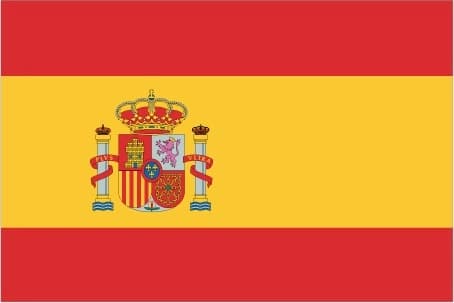
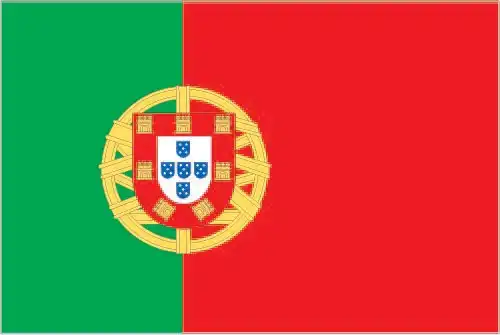
Spain and Portugal share the Iberian Peninsula, much of their early medieval history, and centuries of European maritime exploration — but their flags are very different. Spain's flag, the Rojigualda, is a horizontal triband of red, yellow, and red (with the yellow stripe twice as wide as either red one) and the national coat of arms slightly toward the hoist. Portugal's flag is a vertical bicolor of green and red with a coat of arms set on the dividing line, featuring the national shield and an armillary sphere. Both countries are home to global Romance languages, deep Catholic traditions, and rich heraldic flag designs — and the two flags are constantly displayed together as the joint face of the Iberian Peninsula.
Key Differences
- Spain's flag is a horizontal red-yellow-red triband; Portugal's flag is a vertical green-and-red bicolor.
- Spain's flag uses red and yellow; Portugal's flag uses green and red.
- Spain's coat of arms is set on the yellow stripe, slightly toward the hoist; Portugal's coat of arms straddles the green-red dividing line.
- Spain's yellow stripe is twice as wide as each red stripe; Portugal's green section is two-fifths and the red section is three-fifths of the flag.
- Spain's flag in this form was first adopted in 1785 (as a naval ensign) and made the national flag in 1843; Portugal's current flag was adopted in 1911 after the proclamation of the Portuguese First Republic.
- Spain's coat of arms includes the historic shields of Castile, León, Aragon, and Navarre, plus the Pillars of Hercules; Portugal's coat of arms features the five blue 'quinas' shields, seven castles, and a yellow armillary sphere.
Similarities
- Both flags include red as a major color.
- Both flags carry the national coat of arms in or near the center.
- Both countries are deeply Catholic Iberian states (Spain a constitutional monarchy, Portugal a republic) whose flags carry centuries of heraldic detail.
- Both flags trace some of their iconography back to the Iberian Reconquista (711–1492).
- Both flags are routinely paired in any European Union, Iberian, or Lusophone-Hispanic context.
Why Do Spain and Portugal Flags Look So Similar?
Spain and Portugal are constantly searched and displayed together because they share the Iberian Peninsula, the Latin Christian Catholic tradition, the experience of the Reconquista, and overlapping early-modern empires that together split most of the New World between them after the 1494 Treaty of Tordesillas. They are constantly compared in tourism, sports, food, language (Spanish vs Portuguese), and EU politics. The flags themselves don't share much palette overlap (red is the only common color), but both rely on detailed national coats of arms — a hallmark of European heraldic flag design — and both trace their imagery back to medieval Iberian kingdoms. Side-by-side, they read as a clear visual pair: two complex, red-rich heraldic flags from neighboring Iberian nations.
History of the Spanish Flag
Spain's red-yellow-red Rojigualda was first adopted as a naval ensign on May 28, 1785, by King Charles III, who wanted a more visible Spanish naval flag than the traditional white Bourbon banner. The colors are said to have been chosen for maximum visibility at sea. In 1843, Queen Isabella II made the design Spain's official national flag. Over the centuries, the central coat of arms has changed — most notably during the Second Republic (1931–1939), which used a tricolor of red-yellow-purple, and during the Franco era (1939–1981), which used a different version of the eagle-and-shield emblem. The current coat of arms was adopted on October 5, 1981, after Spain's transition to democracy.
History of the Portuguese Flag
Portugal's current flag was adopted on June 30, 1911, after the 1910 republican revolution that overthrew the monarchy. It replaced the previous blue-and-white royal flag with green and red — the colors of the Portuguese Republican Party. The coat of arms in the center includes the historic Portuguese shield (used since King Afonso I in 1143) on a yellow armillary sphere. The shield contains five smaller blue shields representing the five Moorish kings defeated at the Battle of Ourique in 1139, and a red border with seven gold castles representing fortifications captured from the Moors during the Reconquista. The armillary sphere — a navigational tool — references Portugal's Age of Discovery and its central role in pioneering global maritime exploration.
Color Comparison
Spain Flag Colors
Portugal Flag Colors
Fun Facts
- Spain's red and yellow are popularly said to come from the legend of King Wifred the Hairy of Catalonia, who reportedly drew red stripes on a gold shield with his blood — but this story is medieval folklore, not historical fact.
- Portugal's seven castles on the shield commemorate fortifications captured from the Moors; their number was reduced from twelve to seven by King Afonso III in the 13th century.
- Spain and Portugal divided the non-European world between themselves in 1494 with the Treaty of Tordesillas, which is why Brazil speaks Portuguese while the rest of Latin America largely speaks Spanish.
- Spain's flag, like Portugal's, has a national flag day — Spain's 'Día de la Hispanidad' is October 12 (Columbus Day); Portugal's flag day is celebrated on June 10, Camões Day.
- The Iberian Peninsula has its own informal 'Iberian flag' tradition — the two flags are routinely used together for cultural and tourism branding across both countries.
Frequently Asked Questions
Why do Spain and Portugal flags look alike?
Spain and Portugal are constantly searched and displayed together because they share the Iberian Peninsula, the Latin Christian Catholic tradition, the experience of the Reconquista, and overlapping early-modern empires that together split most of the New World between them after the 1494 Treaty of Tordesillas. They are constantly compared in tourism, sports, food, language (Spanish vs Portuguese), and EU politics. The flags themselves don't share much palette overlap (red is the only common color), but both rely on detailed national coats of arms — a hallmark of European heraldic flag design — and both trace their imagery back to medieval Iberian kingdoms. Side-by-side, they read as a clear visual pair: two complex, red-rich heraldic flags from neighboring Iberian nations.
What is the difference between the Spain and Portugal flag?
- Spain's flag is a horizontal red-yellow-red triband; Portugal's flag is a vertical green-and-red bicolor.
- Spain's flag uses red and yellow; Portugal's flag uses green and red.
- Spain's coat of arms is set on the yellow stripe, slightly toward the hoist; Portugal's coat of arms straddles the green-red dividing line.
- Spain's yellow stripe is twice as wide as each red stripe; Portugal's green section is two-fifths and the red section is three-fifths of the flag.
- Spain's flag in this form was first adopted in 1785 (as a naval ensign) and made the national flag in 1843; Portugal's current flag was adopted in 1911 after the proclamation of the Portuguese First Republic.
- Spain's coat of arms includes the historic shields of Castile, León, Aragon, and Navarre, plus the Pillars of Hercules; Portugal's coat of arms features the five blue 'quinas' shields, seven castles, and a yellow armillary sphere.
Are the Spain and Portugal flags the same?
No, while they look very similar, the flags of Spain and Portugal have distinct differences. Spain's flag is a horizontal red-yellow-red triband; Portugal's flag is a vertical green-and-red bicolor.
Can You Tell Them Apart?
Test your flag knowledge with our interactive quiz!
Play Flag Quiz →Other Similar Flags
Brazil vs Portugal
Compare Brazil's green-and-yellow Auriverde with Portugal's red-and-green flag — two Lusophone flags with shared colonial heritage.
Italy vs Mexico
Italy and Mexico flags both have green, white, and red vertical stripes. The key difference? Mexico adds its coat of arms. Compare their full history and meaning.
France vs Italy
France, Italy, and Ireland all use vertical tricolor flags that are easy to confuse. Compare their colors, history, and how to tell them apart.