USA vs Canada Flag
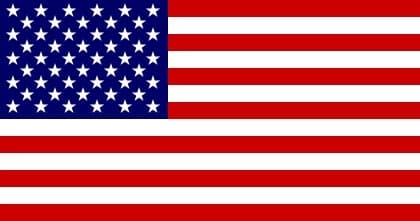
The flags of the United States and Canada are two of the most recognized national symbols in the world, and they're often searched for together because the two countries share a 5,500-mile border, a similar federal structure, and centuries of intertwined history. Visually, however, the flags couldn't be more different. The Stars and Stripes is a busy red-white-and-blue banner of stripes and stars representing each U.S. state and the original colonies. Canada's Maple Leaf is one of the world's most minimalist national flags: two red vertical bands flanking a white square containing a single stylized red maple leaf. The contrast — complex versus minimalist — is part of what makes them an interesting pair to compare.

Key Differences
- The U.S. flag has 50 stars (one per state) and 13 stripes (one per founding colony); Canada's flag has a single 11-pointed maple leaf and no stars or stripes.
- The U.S. flag uses red, white, and blue; Canada's flag uses only red and white.
- The U.S. flag is rectangular with horizontal stripes; Canada's is rectangular with vertical bands and a square center field (a 'Canadian pale').
- The U.S. flag was first adopted in 1777 and has been modified 27 times; Canada's current flag was adopted on February 15, 1965, and has never changed.
- The U.S. flag has a 10:19 aspect ratio; Canada's flag has a 1:2 ratio.
- The U.S. flag is intricate and detailed; Canada's is one of the most minimal national flags in the world.
Similarities
- Both flags are red and white as their two primary colors (the U.S. flag adds blue).
- Both flags use highly distinctive shapes inside the canton or center — stars on the U.S. flag, the maple leaf on Canada's.
- Both flags are deeply tied to national identity and frequently featured in patriotic imagery.
- Both have strict national flag etiquette outlined in formal flag codes.
- Both replaced earlier British-derived designs — the U.S. dropped the Union Jack canton in 1777, and Canada dropped the Red Ensign in 1965.
Why Do United States and Canada Flags Look So Similar?
People search for these flags together because the U.S. and Canada are constantly compared as North American neighbors, allies, and trading partners. Both countries grew out of British colonial rule, both built federal political systems, and both display flags at almost every major international event. Visually, the two flags are also paired in countless logos, sports broadcasts, hockey jerseys, and travel guides. While the designs are very different, the cultural pairing is so common that any visual treatment of North America almost inevitably shows the two flags side by side. The shared red-white palette is the single visual link, and it gives them a surprisingly compatible look when displayed together — which is why they appear as a duo so often in branding.
History of the American Flag
The American flag was adopted by the Second Continental Congress on June 14, 1777, with 13 stars and 13 stripes representing the original colonies. As new states joined the Union, stars were added — but the stripes were locked at 13 by an 1818 act of Congress to honor the founding colonies. The current 50-star design was adopted on July 4, 1960, after Hawaii became the 50th state. It is the longest-serving version of the flag in U.S. history. June 14 is celebrated annually as Flag Day.
History of the Canadian Flag
Canada used the Canadian Red Ensign — a British red ensign with the Canadian coat of arms — informally for decades before the modern Maple Leaf flag was adopted on February 15, 1965, after a fierce parliamentary debate known as the 'Great Canadian Flag Debate.' Prime Minister Lester B. Pearson championed a distinctly Canadian flag without British symbolism. The winning design, by historian George Stanley, features a stylized red maple leaf with 11 points (the number was chosen for visual clarity, not symbolic meaning). February 15 is observed annually as National Flag of Canada Day.
Color Comparison
United States Flag Colors
Canada Flag Colors
Fun Facts
- The maple leaf on Canada's flag has 11 points — chosen because it tested best for visual clarity in wind tunnel tests, not for any symbolic reason.
- The American flag has been to the moon six times during Apollo missions, while Canada's flag has flown aboard the International Space Station with Canadian astronauts.
- The U.S. flag has been redesigned 27 times — every time a new state joined the Union — while Canada's Maple Leaf has remained unchanged since 1965.
- Canada's flag debate in 1964 lasted six months and produced thousands of submitted designs from the public.
- Both countries celebrate official flag days: Flag Day in the U.S. (June 14) and National Flag of Canada Day (February 15).
Frequently Asked Questions
Why do United States and Canada flags look alike?
People search for these flags together because the U.S. and Canada are constantly compared as North American neighbors, allies, and trading partners. Both countries grew out of British colonial rule, both built federal political systems, and both display flags at almost every major international event. Visually, the two flags are also paired in countless logos, sports broadcasts, hockey jerseys, and travel guides. While the designs are very different, the cultural pairing is so common that any visual treatment of North America almost inevitably shows the two flags side by side. The shared red-white palette is the single visual link, and it gives them a surprisingly compatible look when displayed together — which is why they appear as a duo so often in branding.
What is the difference between the United States and Canada flag?
- The U.S. flag has 50 stars (one per state) and 13 stripes (one per founding colony); Canada's flag has a single 11-pointed maple leaf and no stars or stripes.
- The U.S. flag uses red, white, and blue; Canada's flag uses only red and white.
- The U.S. flag is rectangular with horizontal stripes; Canada's is rectangular with vertical bands and a square center field (a 'Canadian pale').
- The U.S. flag was first adopted in 1777 and has been modified 27 times; Canada's current flag was adopted on February 15, 1965, and has never changed.
- The U.S. flag has a 10:19 aspect ratio; Canada's flag has a 1:2 ratio.
- The U.S. flag is intricate and detailed; Canada's is one of the most minimal national flags in the world.
Are the United States and Canada flags the same?
No, while they look very similar, the flags of United States and Canada have distinct differences. The U.S. flag has 50 stars (one per state) and 13 stripes (one per founding colony); Canada's flag has a single 11-pointed maple leaf and no stars or stripes.
Can You Tell Them Apart?
Test your flag knowledge with our interactive quiz!
Play Flag Quiz →Other Similar Flags
United States vs United Kingdom
Compare the Stars and Stripes vs Union Jack — two of the world's most recognizable flags representing the American Revolution's legacy.
United States vs Mexico
Compare the U.S. Stars and Stripes with Mexico's eagle-and-cactus tricolor — two North American flags with very different design traditions.
Australia vs New Zealand
Australia and New Zealand flags both feature the Union Jack and Southern Cross on a blue background. Compare the key differences, history, and symbolism.