USA vs Mexico Flag
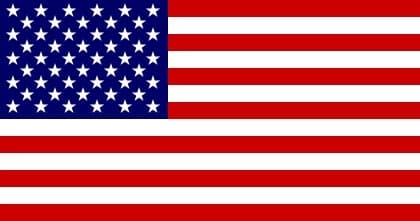
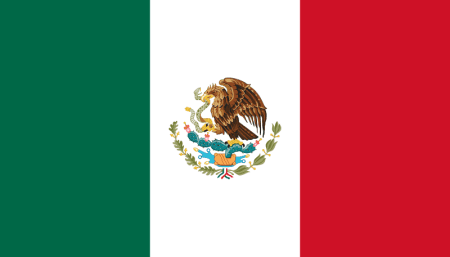
The flags of the United States and Mexico are visually very different but politically inseparable: they fly side by side at countless border crossings, sports events, and diplomatic occasions. The Stars and Stripes uses 50 white stars in a blue canton with 13 red and white stripes; Mexico's flag is a vertical green-white-red tricolor with a striking central emblem of an eagle perched on a cactus, eating a serpent. Both are powerful national symbols of distinct revolutionary traditions — one descended from a break with the British Empire, the other from a break with the Spanish Empire — and both have inspired countless variations across the Americas.
Key Differences
- The U.S. flag has horizontal red and white stripes plus a blue canton with 50 white stars; Mexico's flag has three vertical stripes (green, white, red) with a coat of arms in the center.
- The U.S. flag uses red, white, and blue; Mexico's uses green, white, and red.
- Mexico's central emblem is the iconic eagle-on-cactus-eating-a-serpent — the U.S. flag has no central emblem.
- The U.S. flag was adopted in 1777 and modified 27 times; Mexico's modern flag was adopted on September 16, 1968, with the most recent emblem update in 1968.
- The U.S. flag has a 10:19 ratio; Mexico's has a 4:7 ratio.
- The U.S. flag has stripe-and-star symbolism (states, colonies); Mexico's flag is a vertical tricolor with founding-myth symbolism (the Aztec legend of Tenochtitlan).
Similarities
- Both flags use red and white as primary colors.
- Both are powerful symbols of revolutionary independence — from Britain (1776) and Spain (1810–1821), respectively.
- Both are recognized worldwide and frequently appear together in North American imagery.
- Both have strict flag etiquette codified in national law.
- Both feature complex internal elements (stars and stripes vs the eagle-and-cactus emblem) rather than simple geometric designs.
Why Do United States and Mexico Flags Look So Similar?
Americans and Mexicans search for these flags together because the U.S. and Mexico share North America's longest land border, an enormous trade relationship, and deeply linked cultures. The flags are constantly displayed side by side at sporting events (especially football and boxing), at diplomatic meetings, and in border-region branding. Although the visual languages of the flags are very different — striped horizontal versus tricolored vertical — they share red and white as colors, and both rely on emblematic symbols (stars on one, the eagle-and-cactus on the other) to tell a national story. The pairing is one of the most common 'two-flag' images in North American media.
History of the American Flag
The American flag was adopted on June 14, 1777, by the Second Continental Congress, with 13 stars and 13 stripes for the original colonies. As new states joined the Union, additional stars were added (the stripes were fixed at 13 in 1818). The current 50-star design has been in continuous use since July 4, 1960, after Hawaii's admission, making it the longest-serving version of the U.S. flag.
History of the Mexican Flag
Mexico's flag in its current form was adopted on September 16, 1968, but the green-white-red tricolor dates to 1821, the year Mexico won independence from Spain. The original design carried Agustín de Iturbide's 'Three Guarantees' symbolism — green for independence, white for the Catholic religion, red for union — though those meanings were later reinterpreted. The central coat of arms depicts the founding myth of the Aztec capital Tenochtitlan: an eagle perched on a prickly pear cactus, devouring a serpent, on the spot where the wandering Mexica people were told to settle. The eagle's design has been redrawn several times, most recently in 1968.
Color Comparison
United States Flag Colors
Mexico Flag Colors
Fun Facts
- Mexico's flag is the only national flag in the world that depicts an eagle eating a snake.
- The Aztec legend on Mexico's flag refers to the founding of Tenochtitlan, present-day Mexico City, around 1325.
- Both flags have detailed national flag codes — the U.S. Flag Code and Mexico's 'Ley sobre el Escudo, la Bandera y el Himno Nacionales.'
- Mexico celebrates 'Día de la Bandera' (Flag Day) on February 24 — the day the original Three Guarantees flag was raised in 1821.
- The U.S. and Mexican flags appear side by side on flagpoles at every major U.S.-Mexico border crossing.
Frequently Asked Questions
Why do United States and Mexico flags look alike?
Americans and Mexicans search for these flags together because the U.S. and Mexico share North America's longest land border, an enormous trade relationship, and deeply linked cultures. The flags are constantly displayed side by side at sporting events (especially football and boxing), at diplomatic meetings, and in border-region branding. Although the visual languages of the flags are very different — striped horizontal versus tricolored vertical — they share red and white as colors, and both rely on emblematic symbols (stars on one, the eagle-and-cactus on the other) to tell a national story. The pairing is one of the most common 'two-flag' images in North American media.
What is the difference between the United States and Mexico flag?
- The U.S. flag has horizontal red and white stripes plus a blue canton with 50 white stars; Mexico's flag has three vertical stripes (green, white, red) with a coat of arms in the center.
- The U.S. flag uses red, white, and blue; Mexico's uses green, white, and red.
- Mexico's central emblem is the iconic eagle-on-cactus-eating-a-serpent — the U.S. flag has no central emblem.
- The U.S. flag was adopted in 1777 and modified 27 times; Mexico's modern flag was adopted on September 16, 1968, with the most recent emblem update in 1968.
- The U.S. flag has a 10:19 ratio; Mexico's has a 4:7 ratio.
- The U.S. flag has stripe-and-star symbolism (states, colonies); Mexico's flag is a vertical tricolor with founding-myth symbolism (the Aztec legend of Tenochtitlan).
Are the United States and Mexico flags the same?
No, while they look very similar, the flags of United States and Mexico have distinct differences. The U.S. flag has horizontal red and white stripes plus a blue canton with 50 white stars; Mexico's flag has three vertical stripes (green, white, red) with a coat of arms in the center.
Can You Tell Them Apart?
Test your flag knowledge with our interactive quiz!
Play Flag Quiz →Other Similar Flags
Italy vs Mexico
Italy and Mexico flags both have green, white, and red vertical stripes. The key difference? Mexico adds its coat of arms. Compare their full history and meaning.
United States vs Canada
Compare the American Stars and Stripes with Canada's Maple Leaf — two iconic North American flags with very different histories.
United States vs United Kingdom
Compare the Stars and Stripes vs Union Jack — two of the world's most recognizable flags representing the American Revolution's legacy.